Compare the right galvanized family.
Review heavy-gauge pipes and light-gauge pipes against the specified service and wall. For non-water fencing, railings or frames, compare lightweight steel tubes. A galvanized tube is not automatically a water pipe.
Size, wall, grade, steel input, length, ends and galvanizing affect the quoted cost. Testing, documents, fabrication and order volume add differences beyond nominal diameter. When comparing GI and BI prices, check that the base pipe and quoted inclusions match.
Check what the coating price includes.
Ask how the coating requirement is defined, measured and documented under the relevant product standards. Confirm protection or repair after cutting, threading, bending or welding. Do not treat an attractive surface as proof of the required coating.
Consider the actual exposure and upkeep when comparing the purchase price with installation and future repair costs.
Compare what each quote includes.
Compare the same wall, standard, coating, ends and length. Put piece or metre prices on the same basis, then compare taxes, freight, unloading and partial deliveries. Check payment terms, exclusions and how long the price remains valid.
Send the specification behind the price.
Share the galvanized product requirement, drawings and quantities with the destination and required date. Include the coating and documents already specified. Ask the supplier to confirm availability and the delivery plan with the quote.
Compare GI pipe weight per metre.
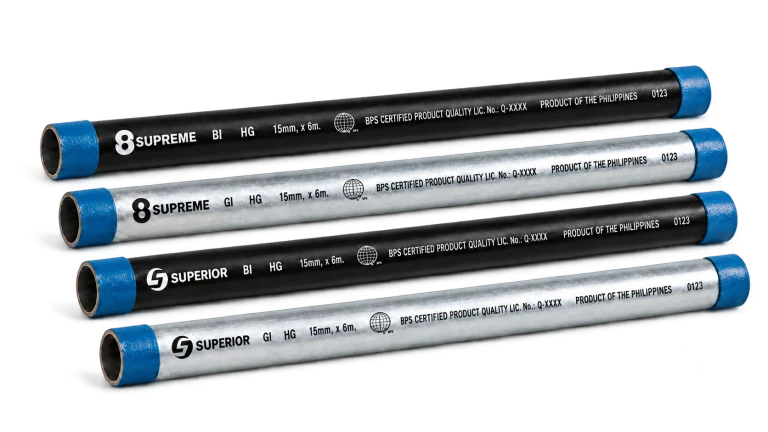
Quotes are easier to compare when they cover the same gauge and nominal size. Heavy-gauge GI pipe (SUPREME and SUPERIOR) and light-gauge GI pipe (TRI-R PIPE) share the same outside diameter at each size, so wall thickness and mass per metre set the steel weight you are paying for (SC p.8, p.10, p.12).
For example, at 50 mm (2 in, 60.3 mm OD), heavy gauge has a 4.0 mm wall and weighs 5.553 kg/m, while light gauge has a 2.9 mm wall and weighs 4.105 kg/m. At 25 mm (1 in, 33.4 mm OD), heavy gauge is 3.4 mm wall at 2.515 kg/m and light gauge is 2.6 mm wall at 1.975 kg/m. Compare full tables on our heavy-gauge pipes and light-gauge pipes pages, or see the 15 mm to 250 mm chart on our GI pipe supplier page.
Common questions about GI pipe price.
Why do two GI pipe quotes differ? Check that both cover the same nominal size, gauge or wall thickness, standard (PNS 26:2018 or ASTM A53), zinc coating, length, order quantity, pipe-end work and delivery point before comparing totals.
Does threading or grooving affect a GI pipe quote? Pipe-end threading, grooving and beveling are offered subject to availability, with threading available up to 150 mm. Specify required end finishes upfront so your quote reflects the complete scope.
What about GI pipe delivery and lead time? Supreme supplies Luzon, Visayas and Mindanao from Meycauayan, Bulacan, Cebu and Davao hubs and authorized distributors. Lead time is estimated at 3–5 working days, subject to stock and to the size, gauge, quantity and delivery site of the order. Confirm the current lead time with your quote.
Where do I request today's GI pipe price? Review our GI pipe supplier and size guide or send your specification and quantities through Request a Quote.
What is the standard length of GI pipe? Most GI pipe is stocked in 6 m lengths. Confirm any other length with your quote.
Do you provide a mill test certificate? A mill test certificate (MTC) is provided with delivery.